
The purge in Washington does not pause the war. Strikes continue, Hormuz remains closed, and Brent crude is still dancing around $109 a barrel. For India, the command chaos in the Pentagon is another layer of uncertainty piled on five weeks of conflict that was already straining every buffer Delhi has.

Glimpses from Vayu Shakti 2026 highlight India's aerial might and combat readiness. From sonic booms to precision strikes, the Indian Air Force showcased its full-spectrum capabilities over Rajasthan skies.

Taking Kharg would give the US control over virtually all of Iran's oil exports and thus provide significant leverage, notes Prem Panicker in his must read daily blog on the Gulf War. It would also put American troops within range of Iran's remaining missiles, drones, and artillery on a piece of real estate that is just eight square miles in size, and just 15 miles from the Iranian mainland.

The delegations from the US and Iran head to Islamabad on Friday, carrying a ceasefire that is already fraying, a Strait that is technically open and practically closed, and a negotiating agenda that would challenge even parties actually negotiating in good faith, which these groups are not. Prem Panicker continues his must read blog on the Iran War.

'India's ties with Israel have to do with defence and general technology.' 'The war changes nothing in what India and Israel hope to get from the relationship.' 'It's not as though India will get significantly more benefits from Iran if India abandons Israel at this time.'

Nobody takes Pakistan seriously and therefore Pakistan's sudden mediating with almost immediate results of a ceasefire seems more contrived than real, points out Vice Admiral Biswajit Dasgupta (retd).

In a region increasingly shaped by competition and coercion, such collaboration strengthens security without confrontation, builds capacity without dependency and promotes order without domination, points out Dr Kumar.
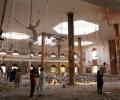
In 2025, India launched Operation Sindoor, a multi-domain combat mission against Pakistan in response to cross-border terrorism. The operation involved precision strikes, military retaliation, and diplomatic measures, marking a significant shift in India's security policy.
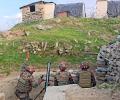
'With a military-led strategy to counter terrorism emanating from Pakistan, India has clearly signalled that it would respond decisively to future terrorist threats.'

Trump may strike. He may announce productive talks and extend again. He may do both at the same time. Iran will not open the Strait on someone else's terms, so no matter what happens, that problem will remain unsolved. And the IRGC will still be collecting its $2 million toll from every ship bold enough to ask permission to pass.
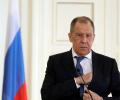
Russian Foreign Minister Sergei Lavrov stated that Russia does not intend to attack Europe, but any attack on Russia would face a devastating response. He also accused the EU's 'war party' of hindering Ukraine peace efforts and pledged support for China on Taiwan.
'Some success has been achieved in raising the costs of terrorism for Pakistan.'
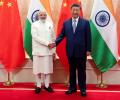
'China's basic purpose of taking the Shaksgam Valley was access to the Indian Ocean.'

The question is no longer whether the war will expand. It has. The next few days will tell us whether the war stabilises around Hormuz or whether the Strait itself becomes the trigger for a far larger rupture. What to watch for over the next 48 hours is simple: Any move by the US toward direct naval control of the Strait; any credible Iranian attempt to disrupt or mine shipping lanes and, critically, whether energy infrastructure in the Gulf continues to be targeted.If those lines are crossed in tandem, the war will no longer be containable within the region.

Alliances fight wars effectively only when they share an endgame. If Israel acted without US knowledge, then the military alliance is operating without real coordination at the level of strategic targeting. Neither picture is reassuring in a war that is no longer regional in its consequences. Prem Panicker continues his must read daily blog on the Gulf War.

The 'rescue' operation occurred within kilometres of Iran's underground tunnel complex at Isfahan, assessed by the IAEA and US intelligence as holding a substantial portion of the country's 60 per cent enriched uranium stockpile. Retired senior US military officers have highlighted that the mission's footprint -- hundreds of special operators, multiple heavy-lift aircraft deep inside Iran -- appears outsized for recovering a single airman. Prem Panicker continues his must read blog on the Iran War.
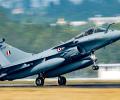
The Indian Defence Ministry has approved the procurement of 114 Rafale fighter jets from France, a significant step towards bolstering the Indian Air Force's combat capabilities. The decision comes ahead of French President Emmanuel Macron's visit to India.

For decades, the Siliguri Corridor was treated as a geographical vulnerability to be quietly managed. Today, it has emerged as a focal point of eastern geopolitics.
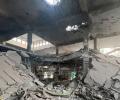
'This operation was a culmination of such long (period) of efforts, and gives us satisfaction that whatever we have been doing, we have been doing correctly'

US President Donald Trump on Wednesday again pushed for control of Greenland, calling it necessary for "national security" and arguing it would also bolster NATO's strength.

The threat of wars hovers over the negotiations in Oman, but the good part is that Trump called the talks to be 'very good' and Iran's President Masoud Pezeshkian responded that they 'constitute a step forward', points out Ambassador M K Bhadrakumar.

The agreement was to disengage from remaining standoff sites along the Line of Actual Control (LAC), two days before a meeting between Chinese President Xi Jinping and Prime Minister Narendra Modi on the sidelines of the BRICS Summit.

The crises of the 21st century, 9/11, the economic meltdown, COVID-19, Russia-Iran war and the Hamas-Israel war seem to be never ending. In this situation, Iran might be contemplating a nuclear deterrent to defend itself, observes Ambassador T P Sreenivasan, the distinguished long-time Rediff contributor who turns 80 on June 17..

'China continues to perceive its relations with India through the prism of India-US relations, with the US using India to counter balance against China in the Indo-Pacific and beyond.'
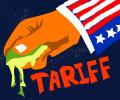
A trade deal makes sense only if it is fair and reciprocal. If the cost is strategic dependence or loss of policy space, waiting is the wiser option, asserts Ajay Srivastava.
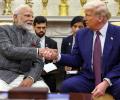
The new US national security strategy signals a retreat from global dominance while reaffirming continuity in India's role in Indo-Pacific security and Quad cooperation, points out former foreign secretary Shyam Saran.
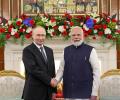
Luckily for us, a Russia that is desperate to stay relevant in an emerging multipolar world finds in India a reliable geostrategic partner. The Russian proximity to India also keeps China from exploiting its economic dominance vis a vis Russia, points out Colonel Anil A Athale (retd).

India and the US have signed a framework agreement for defence cooperation for the next 10 years, enhancing their partnership and aiming for regional stability.

China displayed a range of new weapons at a military parade, including laser weapons, nuclear ballistic missiles, giant underwater drones, and fifth-generation aircraft.
'But that was not our aim. Our objective was already achieved.'

India successfully test-fired the 'Agni 5' intermediate range ballistic missile, capable of reaching targets up to 5,000 km, validating its operational and technical parameters.
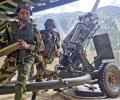
'Will this near-war, India's strongest military response so far, buy India another seven years of deterrence?' asks Shekhar Gupta.

The 2025 US National Security Strategy marks a major pullback, with America turning backward and effectively allowing China greater dominance in Asia. while long-time partners like India are left to face an increasingly unstable global order largely on their own, observes Rajeev Srinivasan.

'The background for the Saudi-Pakistan agreement is the fact that the regional security order has collapsed due to the Israeli attack on Doha.' 'The Americans have largely abandoned their security guarantee for West Asia and the region has no choice but to look at alternatives.'
'There's something called deterrence by punishment.' 'That means you hit in a manner calculated to raise costs and consequences for Pakistan, so that the next time it attempts a Pahalgam-like attack, it has to think ten times.'

The enduring relationship between the two countries have survived the disintegration of the erstwhile USSR in 1991, the end of the Cold War and the regime change in both countries, points out Rup Narayan Das.
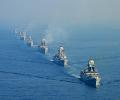
A parliamentary panel on external affairs has expressed concern over China's growing presence and influence in the Indian Ocean Region, citing risks to India's national security and strategic interests. The panel also highlighted the strengthening China-Pakistan naval nexus as a cause for concern.
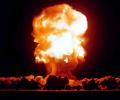
Beijing's latest weapon, 15 times more powerful than TNT, signals a new frontier in high-impact, non-nuclear military technology.

Defence Minister Rajnath Singh on Thursday called upon the top military brass to analyse the conflicts in Ukraine and Gaza as well as the current situation in Bangladesh to "predict" any future problems and stay prepared to deal with the "unexpected".

'What we need to watch is how Saudi Arabia's financial assistance will be used by Pakistan. If the funds go to build their military hardware and operations, it should worry us.'
